
Display Radial Spectrum
Use the 2D Filtering > Display Radial Spectrum option (FFT2SMAP GX) to create a spectrum profile map from the *.SPC file generated by MAGMAP.
Display Radial Spectrum dialog options
|
Input spectrum file |
Specify the name of the input spectrum file. Script Parameter: FFT2SMAP.SPEC |
Application Notes
Mathematically, the Fourier transform of a space domain function f(x,y) is defined as:

The reciprocal relation is:

Where μ and ν are wavenumbers in the x and y directions, respectively, measured in radians per metre when x and y are in metres. These correspond to spatial frequencies ƒx and ƒy, in cycles per metre.
A grid in the spatial domain is transformed to and from the wavenumber domain using the Fast Fourier Transform (FFT). The equivalent (resulting) dataset in the wavenumber domain is called the Transform. A Transform consists of wavenumbers (cycles/metre) with real and imaginary components. Just as a grid samples a space domain function at distance increments, the Transform samples Fourier-domain function at increments of 1/(grid size) cycles/metre, ranging from 0 to the Nyquist wavenumber 1/(2×cell size).
A potential field function in the spatial domain has a unique counterpart in the wavenumber domain, and vice versa. The addition of two functions (anomalies) in the space domain is equivalent to the addition of their Transforms.
The energy spectrum is a 2D function of energy relative to wavenumber and direction. The radially averaged energy spectrum is a function of wavenumber alone and is calculated by averaging energy across all directions for the same wavenumber.
The Fourier transform of the potential field from a prismatic body has a broad spectrum. Its peak location depends on the depth to the prism’s top and bottom surfaces, while its magnitude depends on the prism’s density or magnetization. The peak wavenumber (ω’) can be determined by the following expression:

Where:
ω′: peak wavenumber (radians/metre)
ht: depth to the top
hb: depth to the bottom
The spectrum of a bottomless prism peaks at the zero wavenumber (Bhattacharya, 19661):


Where h is the depth to the top of the prism.
The spectrum for a prism with top and bottom surfaces is:

Where ht and hb are the depths to the top and bottom surfaces, respectively. As the prism bottom is brought up, the peak shifts to higher wavenumbers as illustrated in the following figure:
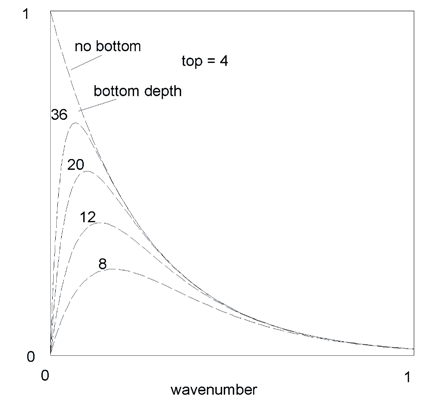
For a fixed-size prism, increasing its depth shifts the spectrum peak to lower wavenumbers (resulting in a broader anomaly) and reduces the spectrum’s magnitude (see illustration below).
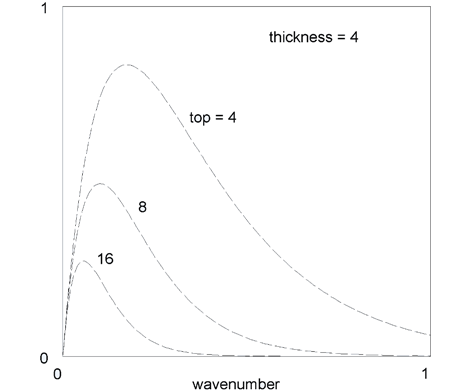
Key observation: For any wavenumber, the spectrum of a deep prism does not exceed that of a shallower prism; only the peak shifts toward lower wavenumbers. Therefore, wavenumber filters cannot separate the effect of deep sources from shallow ones of the same type unless deep sources have stronger magnitudes or shallow sources have smaller depth extents.
For grids large enough to cover multiple sources, the logarithmic spectrum can estimate the statistical depth to source tops using the following relationship:

The depth of an ensemble of sources is determined by measuring the slope of the energy (power) spectrum and dividing it by 4π. A typical energy spectrum for magnetic data has three components: deep source, shallow source, and noise.
The following figure illustrates the division of an energy spectrum into these three components:
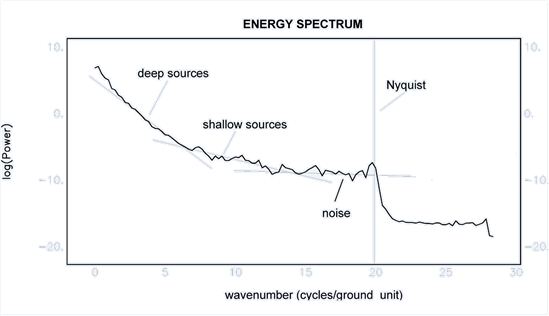
Matched Filtering determines the slope of these three regions and produces the equivalent depth slices.
MAGMAP is commonly used to enhance information in a 2D dataset, either by removing features considered “noise” or by emphasizing features of interest. For example, if you want to highlight shallow features in a magnetic map, you might apply a first or second vertical derivative filter to enhance shallow anomalies while suppressing those caused by deeper sources.
Reference
-
[1] Bhattacharyya, B. K. (1966), "Continuous spectrum of the total-magnetic-field anomaly due to a rectangular prismatic body", Geophysics, Vol. 31, No. 1, pp. 97-121.
Got a question? Visit the Seequent forums or Seequent support
Copyright (c) 2026 Bentley Systems, Incorporated. All rights reserved.
Privacy | Terms of Use