
Eötvös Correction
Use the Moving Platform Gravity > Corrections by Steps > Eötvös Correction menu option (geogxnet.dll(Geosoft.GX.Gravity.EotvosCorrection;Run)*) to calculate the Eötvös correction.
Eötvös Correction dialog options
Application Notes
Earth’s rotation produces an outward centrifugal acceleration. Objects moving across the rotating Earth experience an additional acceleration related to their east–west velocity. This effect is strongest at the equator and decreases with latitude.
-
A body moving east (in the same direction as Earth’s rotation) experiences an increase in centrifugal acceleration.
-
A body moving west experiences a decrease in centrifugal acceleration.
The vertical component of this acceleration, along with a small acceleration related to the motion of the curved Earth, is known as the Eötvös effect. This effect can reach up to 30 milligals (mGal) and must be accounted for in moving platform surveys.
Definition
The Eötvös effect is defined as:
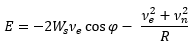
The first term corresponds to the Eötvös effect, while the second term is a refinement with much smaller amplitude.
To account for Earth’s ellipsoidal shape, R can be expanded in terms of Earth’s major axis, flattening, latitude, and observation height, yielding the Exact equation below. Two other published variations of the Eötvös effect are also provided:
[Exact]:

[Harlan, 1968]1:

[Glicken, 1962]2:

Where:
E
Eötvös correction (milligals)
R
Earth’s radius at latitude φ
V
Velocity (knots)
Ws
Angular velocity of Earth’s rotation = 7.2921158533 x 10⁻⁵ rad/s
a
Earth's equatorial radius (semi-major axis)
b
Earth's polar radius (semi-minor axis)
e
Earth’s eccentricity = 0.0818191908426
f
Earth's flattening = (a - b) / a
h
Observation height (above the geoid)
ra
Earth’s major axis = 6378137.0 m
rb
Earth’s minor axis = 6356752.3141 m
νe and νn
Velocities in the easting & northing directions, derived from heading and velocity channels
α
Heading (direction of movement of the vehicle, measured clockwise from true north)
ε
Earth's flattening correction toward the poles = (ra - rb) / ra
φ
Latitude of the vehicle

References
- [1] R. B. Harlan, "Eötvös corrections for airborne gravimetry", Journal of Geophysical Research, vol 73, no 14 (July 15, 1968).
- [2] M. Glicken, "Eötvös corrections for a moving gravity meter", Geophysics, vol 27, no 4 (1962), pp. 531-533.
*GX.NET tools are embedded in the geogxnet.dll file located in the \Geosoft\Desktop Applications\bin folder. To run this GX interactively (outside the menu), navigate to the bin directory and specify the GX.NET tool in the required format. See the Run GX topic for more guidance.
Got a question? Visit the Seequent forums or Seequent support
Copyright (c) 2026 Bentley Systems, Incorporated. All rights reserved.
Privacy | Terms of Use