
Downward Continuation (CNDN)
Use the Downward Continuation option to apply a downward continuation filter.
Downward Continuation dialog options
|
Distance to downward continue |
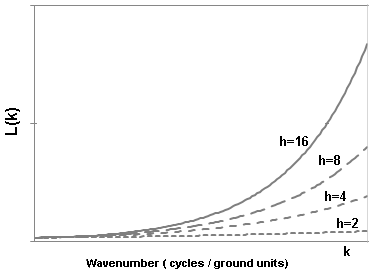
The distance h, in ground units relative to the plane of observation, by which the data will be downward continued. |
Application Notes
Downward continuation enhances the response of deeper sources by effectively bringing the observation plane closer to them. However, downward continuation cannot theoretically be carried through a potential‑field source. Because short‑wavelength signal may appear to originate from shallow sources, it must be removed to prevent high amplitude and short wavelength noise in the processed data.
To stabilize the process, it is common practice to apply a low‑pass filter, such as a Butterworth filter or an Optimum Wiener filter, before applying downward continuation.
A radially averaged energy spectrum can help determine:
-
the wavenumber beyond which shallow (noise‑dominated) components begin to dominate, and
-
the practical limit (depth) to which the data can be safely downward continued.
Downward Continuation

Where:
|
h |
Distance, in ground units, relative to the plane of observation by which the field is continued downward. |
Wavenumber Domain Variable Definitions
|
The following variables are used in the wavenumber domain: |
||
|
k |
Wavenumber increment, used to depict a radially symmetrical variable. |
Where: np: number of points cs: cell size |
|
μ |
X-component of the wavenumber. |
|
|
v |
Y-component of the wavenumber. |
|
|
r |
Radial component of the wavenumber. |
|
|
θ |
Angular (polar) component of the wavenumber. |
|


Ground unit refers to the survey ground units defined in your grid (e.g., metres or feet). Ground units may be left undefined.
Got a question? Visit the Seequent forums or Seequent support
Copyright (c) 2026 Bentley Systems, Incorporated. All rights reserved.
Privacy | Terms of Use