
Cosine Roll-off (COSN)
Use the Cosine Roll-off option to apply a cosine roll-off filter.
Cosine Roll-off Filter dialog options
|
Long wavelength cutoff |
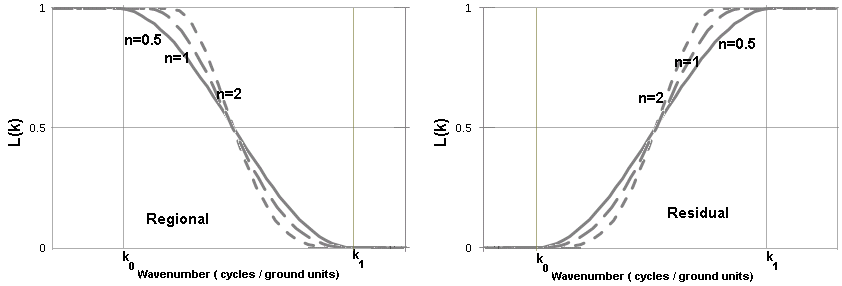
The starting wavelength roll-off, in ground units. As shown in the illustration, this parameter is equivalent to k0-1. |
|
Short wavelength cutoff |
The ending wavelength roll-off, in ground units. As shown in the illustration, this parameter is equivalent to k1-1. |
|
The degree n of the cosine function. Higher values of n produce a sharper roll‑off. The default value is 2. |
|
|
|
Select Low pass to generate the regional field. (Default) Select High pass to apply the reciprocal filter, which produces the residual field. |
 Low pass or
  High pass
Application Notes
This filter has a smooth, continuous roll‑off, and it does not alter the energy spectrum below the start of roll‑off in low‑pass mode (or above the end of roll‑off in high‑pass mode). For this reason, it is commonly used for simple high‑pass or low‑pass operations.
To reduce ringing effects, the separation between k1 and k0 can be increased.
Cosine roll-off filter

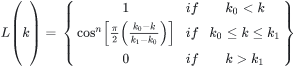
Where,
|
k0 |
Starting wavelength roll-off. |
|
k1 |
Ending wavelength roll-off. |
|
n |
Positive integer controlling the sharpness of the cutoff. |
Wavenumber Domain Variable Definitions
|
The following variables are used in the wavenumber domain: |
||
|
k |
Wavenumber increment, used to depict a radially symmetrical variable. |
Where: np: number of points cs: cell size |
|
μ |
X-component of the wavenumber. |
|
|
v |
Y-component of the wavenumber. |
|
|
r |
Radial component of the wavenumber. |
|
|
θ |
Angular (polar) component of the wavenumber. |
|


Ground_unit is the survey ground units as defined in your grid (e.g. metre or feet). Ground units may be left undefined.
Got a question? Visit the Seequent forums or Seequent support
Copyright (c) 2026 Bentley Systems, Incorporated. All rights reserved.
Privacy | Terms of Use