
Derivative in the X, Y, Z Direction (DRVXYZ)
Use the Derivative option to apply a derivative filter in the X, Y, or Z direction.
Derivative Filter dialog options
|
Direction |
Specifies the direction of the derivative to be applied: X, Y, or Z. The default direction is typically Z. |
|
Order of differentiation |
Sets the order n of the derivative. The default is a 1st‑order derivative. See the Application Notes below for a mathematical illustration of the vertical derivative. |
Application Notes
Filter Operators by Direction
The following table summarizes the mathematical operators for the derivative filters in the wavenumber domain.
Derivation Direction
Filter Operator
X
L(u) = (i μ) n Y
L(v) = (i v) n Z
L(r) = r n
The filter operator in the wavenumber domain is expressed in terms of the wavenumber domain variables μ and ν.
Wavenumber (Fourier) Transform Definition
Mathematically, the Wavenumber (Fourier) transform F(μ,v) of a 2D space domain function f(x,y) is defined as:

Where:
- x, y: Spatial domain variables
- μ, v: Wavenumber domain variables
- i: The imaginary unit (√-1)
X‑ and Y- Derivatives in the Wavenumber Domain
The x derivative of Eq. (1) is:



Comparing (1) & (2), the Fourier transform of the X derivative is:

By analogy, the Fourier transform of the Y derivative is:

Vertical Derivatives and Laplace’s Equation
The vertical derivative is derived using Laplace's equation. For potential fields (like gravity or magnetism) in a source-free region, the field ϕ satisfies Laplace's equation, which states that the divergence of its gradient is zero.
Laplace's Equation (Spatial Domain):

In Cartesian coordinates, this is expressed as:


This can be transformed to the Wavenumber domain to express the vertical second derivative in terms of the horizontal second derivatives:



Referring back to (4):
The second vertical derivative filter (in the wavenumber domain) is:


Therefore, the operator for the first-order vertical derivative in the wavenumber domain is:


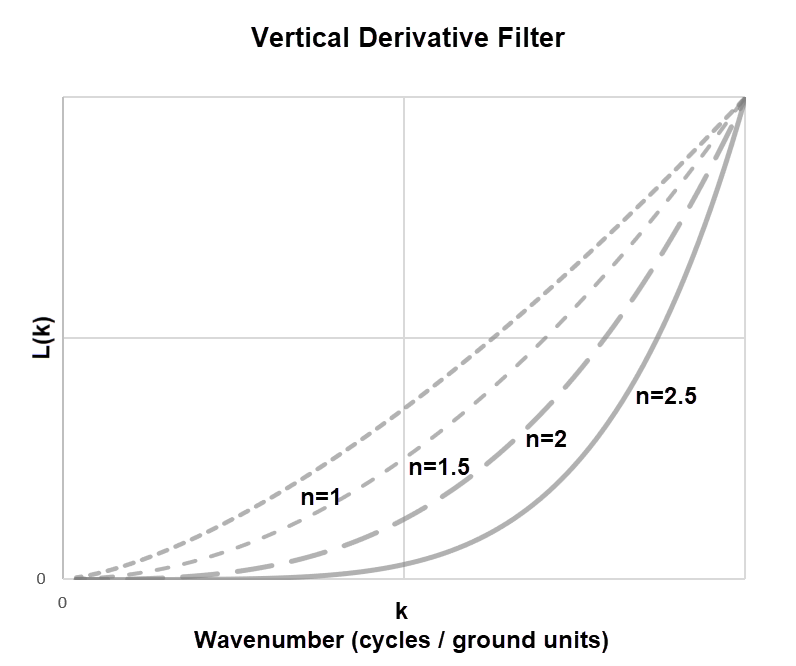
Interpretation of Derivative Filters
-
The horizontal derivatives have similar magnitude response curves to the vertical derivative. However, they are out of phase relative to the amplitude of the transform grid.
-
Horizontal derivatives are commonly used for creating shaded-relief images and are required for specific modelling algorithms such as Euler deconvolution.
Wavenumber Domain Variable Definitions
|
The following variables are used in the wavenumber domain: |
||
|
k |
Wavenumber increment, used to depict a radially symmetrical variable. |
Where: np: number of points cs: cell size |
|
μ |
X-component of the wavenumber. |
|
|
v |
Y-component of the wavenumber. |
|
|
r |
Radial component of the wavenumber. |
|
|
θ |
Angular (polar) component of the wavenumber. |
|


Got a question? Visit the Seequent forums or Seequent support
Copyright (c) 2026 Bentley Systems, Incorporated. All rights reserved.
Privacy | Terms of Use