
Reduce to Magnetic Pole (REDP)
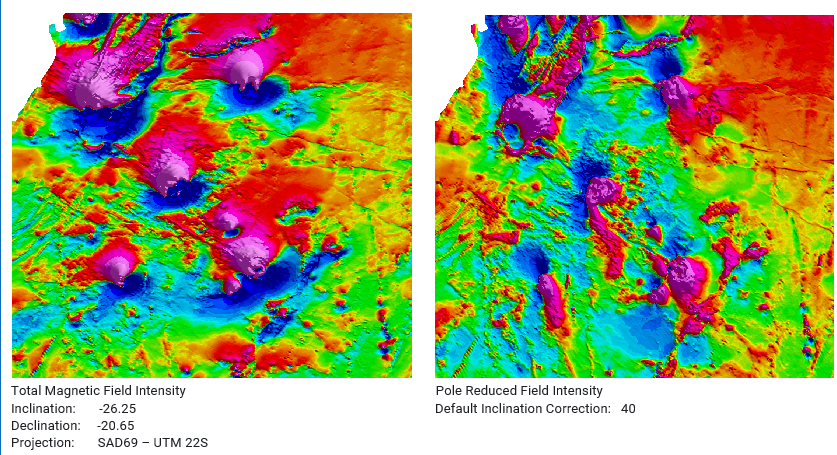
Use the Reduce to Magnetic Pole option to apply the reduction‑to‑pole filter.
Reduce to Magnetic Pole dialog options
Application Notes
The IGRF parameters of an input magnetic grid depend on its geolocation and survey date.
If the grid does not have a coordinate system defined, you will be prompted to assign one.
Once calculated, the IGRF parameters are added to the workspace and used by several MAGMAP filters:
-
The IGRF field strength is required for calculating apparent susceptibility.
-
The IGRF field direction (inclination and declination) is used in the reduction to the pole.
Field strength, inclination, and declination are calculated together to ensure they remain synchronized.
Stability considerations at low magnetic latitudes
Reduction to the Pole includes:
-
Amplitude component: sin(I)
-
Phase component: i cos(I) cos(D-θ)
At near‑equatorial latitudes, the RTP filter becomes unstable near the declination direction, producing dominant artificial trends that obscure real geologic features.
To mitigate this, an amplitude‑modulating inclination Ia is introduced.
This reduces instability but results in under‑correction of amplitudes for features aligned with the declination direction.
To minimize amplitude distortion in low latitudes, Ia should be chosen relative to I—large enough to counteract instability but small enough to minimize amplitude distortion.
Reduce to Magnetic Pole Equation

|
| if | Ia | < | I |, Ia = I |
Where:
|
I |
Geomagnetic inclination (°). |
|
D |
Geomagnetic declination (° azimuth from north). |
|
Ia |
Inclination for amplitude correction (never less than I) ->
|

Wavenumber Domain Variable Definitions
|
The following variables are used in the wavenumber domain: |
||
|
k |
Wavenumber increment, used to depict a radially symmetrical variable. |
Where: np: number of points cs: cell size |
|
μ |
X-component of the wavenumber. |
|
|
v |
Y-component of the wavenumber. |
|
|
r |
Radial component of the wavenumber. |
|
|
θ |
Angular (polar) component of the wavenumber. |
|


Got a question? Visit the Seequent forums or Seequent support
Copyright (c) 2026 Bentley Systems, Incorporated. All rights reserved.
Privacy | Terms of Use