
Apparent Susceptibility Calculation (SUSC)
Use the Apparent Susceptibility Calculation option to apply the apparent susceptibility calculation filter.
Apparent Susceptibility Calculation dialog options
Application Notes
Apparent Susceptibility Calculation
A susceptibility filter is a compound filter that performs:
-
reduction to the pole
-
downward continuation to the source depth
-
correction for the geometric effect
-
division by the total magnetic field
to yield susceptibility.
Apparent susceptibility mapping assumes a simple geometric model. The response is assumed to be caused by a collection of vertical, square-ended prisms of infinite depth extent, whose horizontal dimensions are equal to the input grid‑cell size. This is an idealized approximation—hence the term apparent.
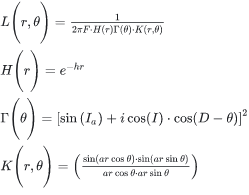
Where:
|
I |
Geomagnetic inclination in ° |
|
D |
Geomagnetic declination in ° azimuth |
|
h |
Depth in ground units, relative to the observation level |
|
Ia |
Inclination for amplitude correction (never less than I) Default is ±20°. If |Ia| is specified to be less than |I|, it is set to I. |
|
a |
½ cell size |
Wavenumber Domain Variable Definitions
|
The following variables are used in the wavenumber domain: |
||
|
k |
Wavenumber increment, used to depict a radially symmetrical variable. |
Where: np: number of points cs: cell size |
|
μ |
X-component of the wavenumber. |
|
|
v |
Y-component of the wavenumber. |
|
|
r |
Radial component of the wavenumber. |
|
|
θ |
Angular (polar) component of the wavenumber. |
|


Ground unit refers to the survey ground units defined in your grid (e.g., metres or feet). Ground units may be left undefined.
The elevation of gridded magnetic data is constant (or close approximation).
Susceptibility Filter Assumptions
The susceptibility filter operator calculates the apparent magnetic susceptibility of the magnetic sources using the following assumptions:
-
The IGRF has been subtracted from the input magnetic field prior to filtering.
-
There is no remanent magnetization.
-
All magnetic response is caused by a collection of vertical, square-ended prisms of infinite depth extent.
-
The resulting susceptibility data is dimensionless (cgs units).
The validity of the results depends on how closely the actual observed field conforms to these assumptions.
To calculate the IGRF parameters, the date and geographic location are required.
If this information is not already supplied, you will be prompted to define it.
The IGRF field strength is required only for apparent susceptibility calculation, but it is recalculated—along with inclination and declination—in the other controls to ensure values remain synchronized.
Got a question? Visit the Seequent forums or Seequent support
Copyright (c) 2026 Bentley Systems, Incorporated. All rights reserved.
Privacy | Terms of Use