
Seequent Evo Drilling Campaigns
Planned borehole groups can be published to and imported from Seequent Evo as drilling campaign geoscience objects. Drilling campaign objects act as a shared container for planned trajectories and interim results, making it easier to track drilling progress against the original plan.
The rest of this topic describes publishing, importing and reloading planned borehole groups. It is divided into:
- Publishing to Seequent Evo
- Importing a Drilling Campaign From Seequent Evo
- Reloading a Drilling Campaign
- Displaying Drilling Campaign Progress
See Borehole Planning Groups for an overview of working with borehole groups in Leapfrog Works.
Publishing to Seequent Evo
When a planned borehole group is published to Seequent Evo, the information published is:
- Collar locations
- Planned paths
- Any model evaluations
To publish planned borehole group to Seequent Evo, right-click on the group in the project tree and choose Publish to Seequent Evo. In the window that appears, choose the workspace you wish to publish to, then click Publish. See the Publishing Data to Seequent Evo topic for more information on the publishing process.
Importing a Drilling Campaign From Seequent Evo
Leapfrog Works can import drilling campaign geoscience objects from Evo where the boreholes are single-segment holes that have no deviation or are naturally deviated; boreholes with directed deviation segments cannot be imported.
In addition, although drilling campaign geoscience objects may contain evaluations, when a drilling campaign is imported from Evo, only the collar locations and paths are included.
To import a drilling campaign from Evo, right-click on the Planned Boreholes folder and choose Import From Seequent Evo. Select the workspace that contains the data you wish to import. For more information on importing objects from Evo, see the Importing Data from Seequent Evo topic.
Reloading a Drilling Campaign
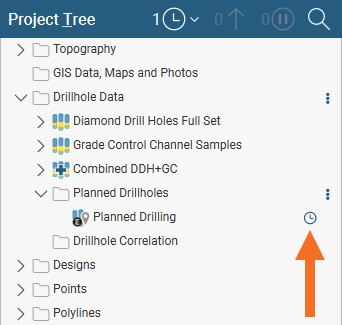
When an object imported from Evo is updated in Evo, a status indicator will appear in the Leapfrog Works project tree alongside the object that has changed. For example, there is a newer version of this drilling campaign available in Evo:
To update the object, right-click on it in the project tree and choose Reload From Seequent Evo:
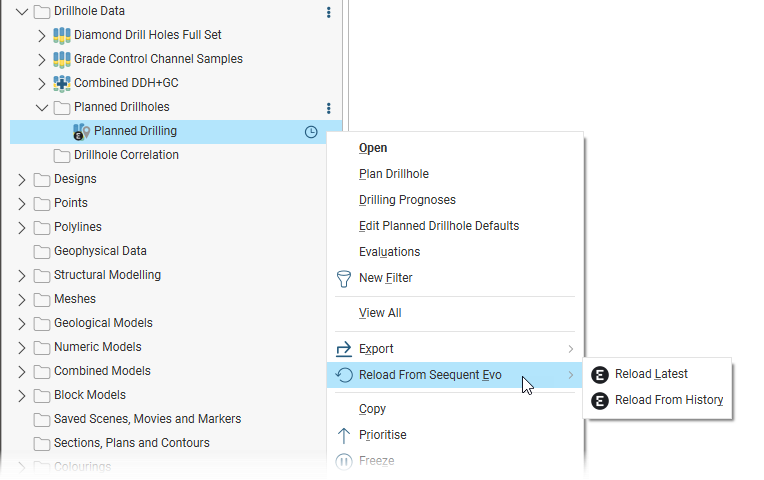
You can reload the latest version available in Evo or choose which version of the drilling campaign you wish to load.
See the Updating Out-of-Date Seequent Evo Objects topic for more information on updating changed objects.
Displaying Drilling Campaign Progress
Drilling campaign objects created by other tools and stored in Seequent Evo can be opened in Leapfrog Works to communicate interim progress in drilling campaigns against the planned boreholes.
From the Planned Boreholes folder, select Import from Seequent Evo and select a drilling campaign with as-drilled data. A planned borehole group will be added to the folder, with a child as-drilled object nested below it.
You can add this planned borehole group to the scene and the as-drilled group will be added to the scene along with it. You cannot add the as-drilled group by itself as it is part of the planned borehole group.
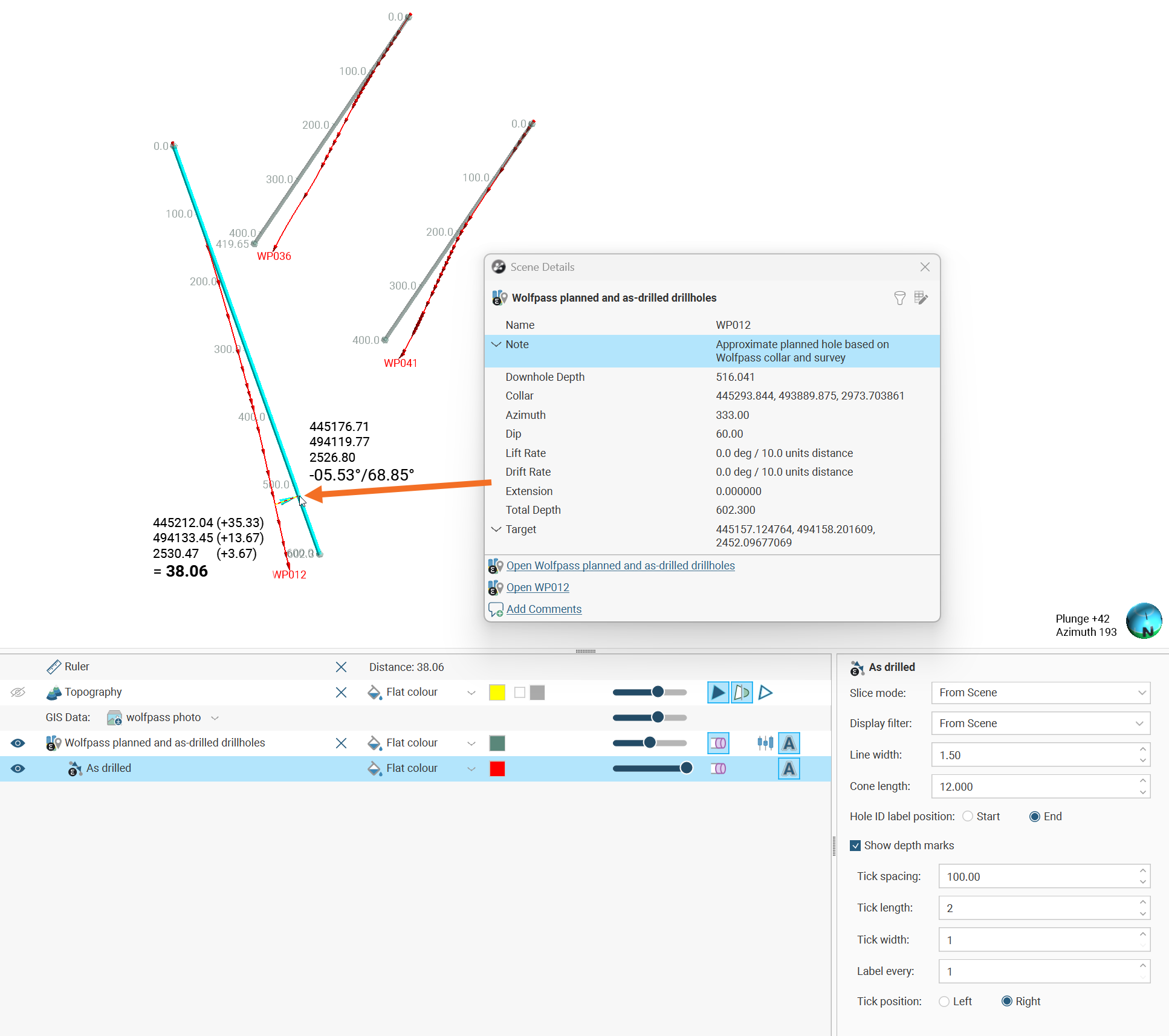
Alongside the planned borehole, a survey trace will appear showing the as-drilled path, with survey cones pointing out the directions recorded in the survey data.
Open the as-drilled data object in the project tree and a collar and a survey table will open. These cannot be edited, and must be updated using the tools that write the data into Seequent Evo. Within Leapfrog Works you can choose to ignore rows within these tables, however. The planned borehole group can be edited inside Leapfrog Works.
Click on a planned borehole object in the scene, and you will get, not only a scene details window with information about the object at that location, but a ruler will also be added to the scene between the selected point on the planned borehole and the corresponding point in the as-drilled survey trace. The deviation calculation, information about the separation between those points, will appear in the scene also.