
Cosine Roll-off Bandpass (COSNB)
Use the Cosine Roll-off Bandpass option to apply a cosine roll-off bandpass filter.
Cosine Roll-off Bandpass Filter dialog options
|
Long wavelength cutoff |
The long wavelength central cutoff, in ground units. |
|
Short wavelength cutoff |
The short wavelength central cutoff, in ground units. |
|
Controls the sharpness of the filter operator. The default value is 2. |
Application Notes
The Cosine roll‑off bandpass filter allows mid‑range wavelengths to pass while attenuating both low and high extremes of the wavenumber spectrum.
The degree of the cosine function controls the sharpness at the two cutoff boundaries. Higher degrees produce a bandpass operator that more closely approximates the ideal bandpass response.
However, caution is advised: an ideal bandpass filter introduces significant ringing artifacts. A commonly used alternative is the Cosine Roll-off (COSN) filter, which provides smoother transitions.
Cosine Bandpass Filter
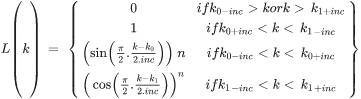
Where:
|
k0 |
Low wavenumber cutoff, in cycles per ground unit. |
|
k1 |
High wavenumber cutoff, in cycles per ground unit. |
|
inc |
Wavenumber width, defined as max(3, n/10). |
|
n |
Number of data points in the wavenumber domain. |
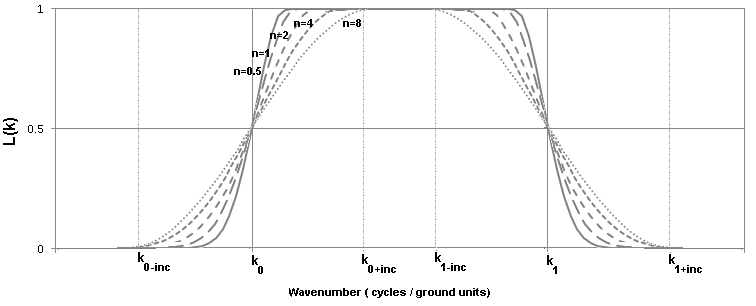
Wavenumber Domain Variable Definitions
|
The following variables are used in the wavenumber domain: |
||
|
k |
Wavenumber increment, used to depict a radially symmetrical variable. |
Where: np: number of points cs: cell size |
|
μ |
X-component of the wavenumber. |
|
|
v |
Y-component of the wavenumber. |
|
|
r |
Radial component of the wavenumber. |
|
|
θ |
Angular (polar) component of the wavenumber. |
|


Ground unit refers to the survey ground units defined in your grid (e.g., metres or feet). Ground units may be left undefined.
Got a question? Visit the Seequent forums or Seequent support
Copyright (c) 2026 Bentley Systems, Incorporated. All rights reserved.
Privacy | Terms of Use