
BlockSync
A BlockSync block model is a cloud-hosted, version-controlled geoscience object stored in a Seequent Evo workspace. It serves as a “system of record” that allows multiple team members to collaboratively update, validate and merge changes against the BlockSync model, creating a shared master record. Team members can check out and work in spatial or attribute subsets and publish updates back to BlockSync targeted only to the area they have checked out.
When an update is made to a subset of the model, values from the previous version are used for the blocks and attributes not covered by the update. For sub-blocked models, updates to spatial subsets may require new sub-block geometry in order to complete a parent cell. For fully sub-blocked and octree sub-blocked models, sub-blocking infilling can be used to automatically derive the missing values based on the parent block’s data, ensuring that the resulting version remains complete and consistent.
This topic provides a brief introduction to BlockSync and links to topics that provide more information. This topic is divided into:
- Signing in to BlockSync
- Evo workspaces and BlockSync
- Supported file formats and block model types
- An important warning on grid definition
- Block model version numbering
Signing in to BlockSync
To work in BlockSync, visit blocksync.seequent.com and sign in using your Bentley account.
Once you have signed in, you will see a list of all the block models you have permissions for:
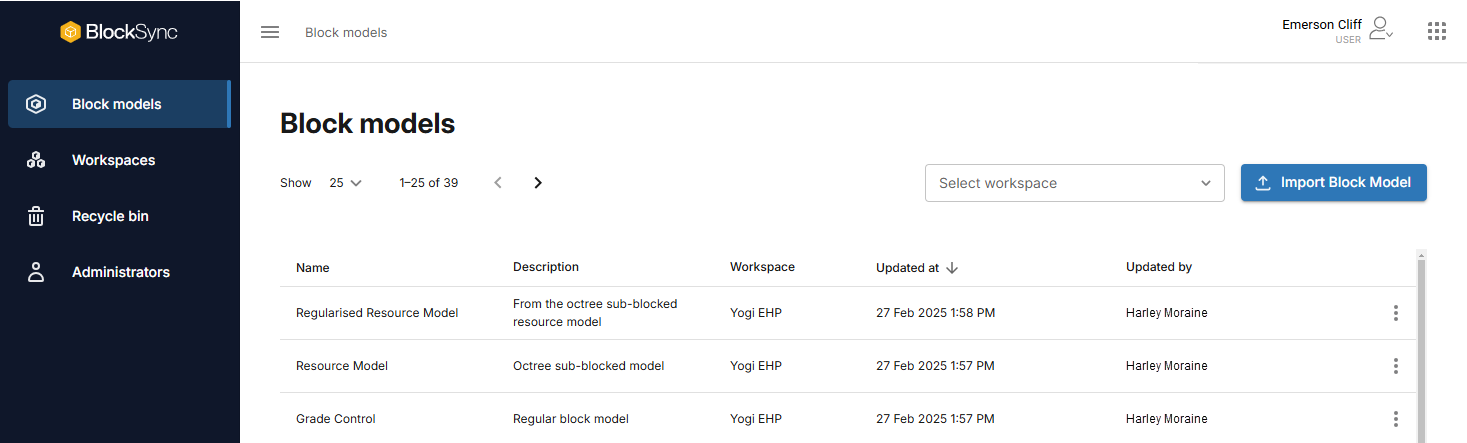
Click the Import block model button to start the process of importing a new block model. See the Importing block models topic.
Click on a block model to view more information about it. See the Managing BlockSync models topic.
Evo workspaces and BlockSync
Workspace permissions determine who can access a workspace and make changes to it. There are three permission levels: owners, editors and viewers. The Workspace permissions topic explains these levels in more detail.
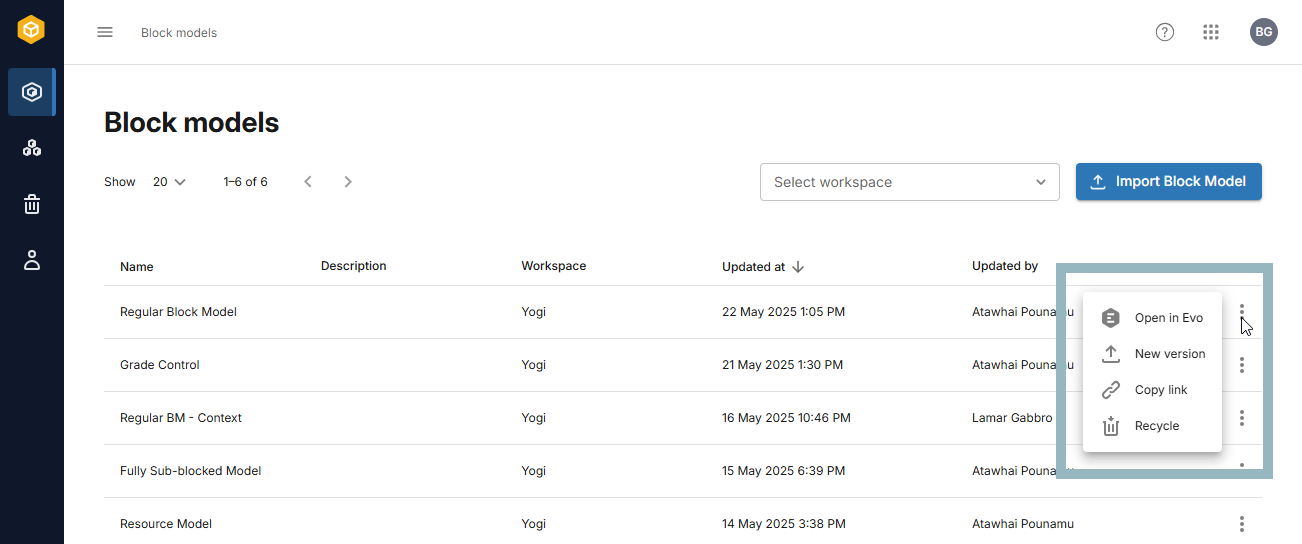
Each block model has an overflow menu ( ):
- Open in Evo opens the block model in the Evo portal. There you can view the block model alongside other data in the workspace. See the Geoscience objects and Workspaces topics for more information.
- New version starts the process of uploading a new version of the block model.
- Copy link copies a link to the model that you can share with other members of your team. Note that the link will only work for those who have been invited to the workspace the block model is in.
- Recycle sends the block model to the recycle bin. See Recycling and restoring block models in the Managing BlockSync models topic.
If you belong to many workspaces, you can filter the list of block models to show only the models in a specific workspace:
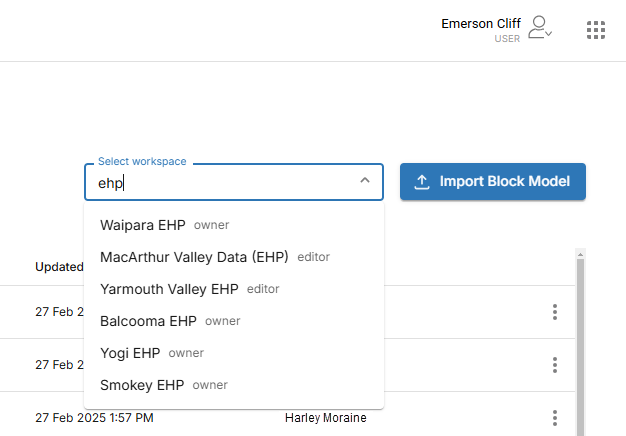
What permission level you have for each workspace is displayed in the dropdown list, which may help narrow down the workspace you are looking for.
Supported file formats and block model types
You can upload block models to BlockSync in the following formats:
- *.csv
- *.parquet
- *.dm (Datamine)
Block model types supported are:
- Regular block models. A regular block model has blocks that are all the same size and are never divided.
- Octree sub-blocked models. An octree sub-blocked model has blocks that are repeatedly halved where selected triggering surfaces intersect the blocks. Instead of dividing a block entirely into small sub-blocks when sub-blocking is triggered, the block is first divided in half in a particular direction, and then only the partitioned blocks that still trigger a further division are divided into smaller units. This creates a series of sub-blocks of different sizes, and because many are larger than the smallest sub-block and the smallest sub-blocks only exist where a contact requires it, processing can be more efficient.
- Fully sub-blocked models. With fully sub-blocked models, blocks are fully sub-divided when they contain a triggering boundary. This can create many sub-blocks and so processing a fully sub-blocked model can be slower than processing an octree sub-blocked model. In contrast to octree sub-blocked models, however, fully sub-blocked models support block subdivisions using numbers other than power-of-two numbers. Fully sub-blocked models do not support variable height sub-blocks.
- Flexible sub-blocked models. With flexible sub-blocked models, sub-blocks can be any size that is an increment of the minimum block size. This is the method of sub-blocking used by Vulcan.
An important warning on grid definition
Once a block model has been uploaded to BlockSync, its grid definition cannot be changed. If you later need to upload a version of the model that has a different grid definition, you will need to upload it as a new model.
Block model version numbering
When a block model is first uploaded to BlockSync, two versions of the model are created:
- Version 1 is the empty model based on the grid definition. Once a block model has been created in BlockSync, its definition cannot be changed.
- Version 2 populates the model definition with data, i.e. its data columns.
A model’s version history is linear, with no branching. Each update to the model creates a new version of the entire model.
The version history cannot be edited and versions cannot be deleted. To ‘rollback’ a model, download the version you wish to use as the latest version and upload it again to make it the latest version.
New versions of a block model can be published via integrated applications. They can also be uploaded via the BlockSync portal, which is described in the Importing block models topic.